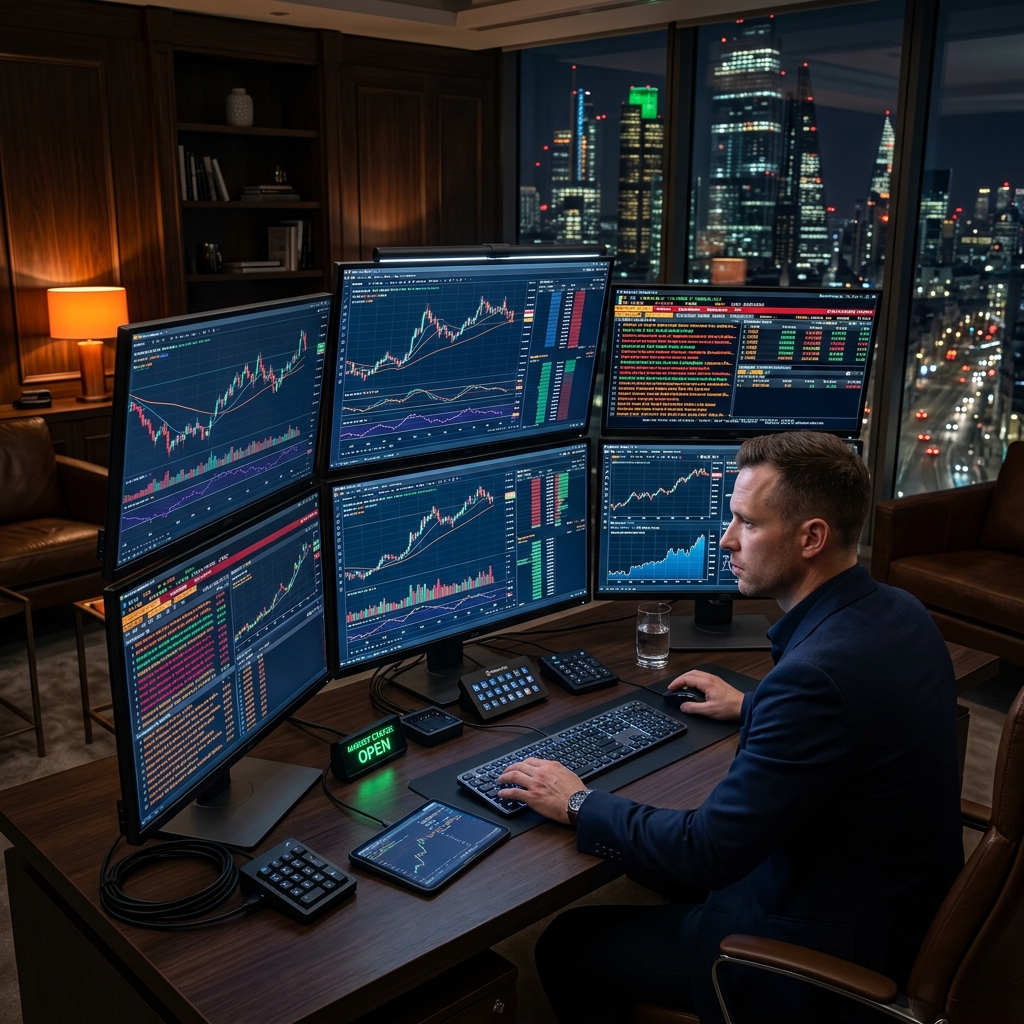
High latency is an invisible, yet often costly, adversary for forex traders. In a market where milliseconds can differentiate profit from loss, a slow connection to your broker's server can severely impact execution quality, leading to frustrating slippage and missed opportunities. For traders operating far from major financial hubs, overcoming this geographical disadvantage is paramount. The practical solution often lies in leveraging local Virtual Private Server (VPS) nodes.
Why Latency Kills Forex Profits
Imagine you've identified a perfect entry point based on your strategy. You click 'buy' or your Expert Advisor (EA) sends the command. If your internet connection and the physical distance to your broker's server are significant, that command takes longer to reach the server. By the time it arrives, the price may have moved, resulting in a fill at a less favorable rate - this is slippage. For high-frequency traders, scalpers, or news traders, even a few tens of milliseconds can render a strategy unprofitable.
Consider a trader in Lagos, Nigeria, trying to execute trades with a broker whose primary servers are in London or New York. The data has to travel thousands of kilometers. This physical distance inherently introduces latency, meaning higher ping times and slower order execution. While local internet infrastructure plays a role, the fundamental issue is often the sheer geographical gap between the trader's terminal and the broker's matching engine.
Understanding Local VPS Nodes
A VPS is essentially a virtual computer running on a remote server. When we talk about a local VPS node in the context of forex, we mean a VPS that is physically located very close to your broker's trading servers. The goal is to minimize the network distance between your trading platform (running on the VPS) and the broker's server.
Instead of your trade signal traveling from your home computer in, say, Johannesburg, all the way to a broker in London, it travels from your home to your VPS in London (which might still be a significant journey) and then only a few kilometers, or even meters, from the London VPS to your broker's London server. This drastically reduces the critical 'last mile' latency.
Key Benefits for Traders
Implementing a local VPS offers several distinct advantages:
- Reduced Ping Times: This is the primary benefit. By hosting your MT4/MT5 platform directly within the same data center, or an adjacent one, as your broker, ping times can drop from hundreds of milliseconds to under 10ms, sometimes even 1-2ms.
- Improved Execution Speed: Lower latency directly translates to faster order transmission and execution, reducing the likelihood of slippage and ensuring your trades are filled closer to your intended price.
- Enhanced Reliability: A dedicated forex VPS typically boasts enterprise-grade hardware, robust power backup, and redundant internet connections. This means your trading platform runs 24/7 without interruption from local power outages, internet service provider issues, or computer crashes at your home.
- Optimal EA Performance: Expert Advisors rely on continuous, low-latency data feeds and rapid execution. A VPS provides the stable, high-performance environment EAs need to operate at their peak efficiency.
Choosing the Right Local VPS Provider
Selecting a suitable VPS isn't just about finding the cheapest option. Practical considerations are critical:
1. Proximity to Your Broker's Server
This is non-negotiable. You need to identify where your broker's main trading servers are located. Often, brokers will list this information, or you can perform a traceroute from your local machine to their server IP address. Common locations include London (LD4/LD5), New York (NY4), Tokyo, Frankfurt, and Amsterdam. Once you know your broker's location, seek out VPS providers with data centers in that exact city, or even within the same data center facility if possible.
2. Hardware Specifications
While forex trading platforms aren't typically resource hogs, you still need adequate resources:
- RAM: At least 1GB per MT4/MT5 instance you plan to run. 2GB is a safer minimum for a single platform, allowing for browser use or other light tasks.
- CPU: 1-2 cores are usually sufficient for a few MT4/MT5 instances. Prioritize a provider using modern, high-clock-speed processors.
- Storage: 30-50GB SSD (Solid State Drive) is generally enough. SSDs are crucial for faster loading and overall responsiveness.
3. Network Uptime and Redundancy
Your trading platform needs to be online constantly. Look for providers guaranteeing 99.9% uptime or higher. Inquire about their network redundancy and power backup systems. A VPS that frequently goes offline negates all latency benefits.
4. Operating System and Management
Most forex VPS solutions run Windows Server (e.g., 2012 R2, 2016, 2019) because MT4/MT5 are Windows-based applications. Ensure the provider offers a Windows OS and easy remote access via RDP (Remote Desktop Protocol).
5. Pricing and Support
Compare pricing, but don't let it be the sole deciding factor. A slightly more expensive VPS with superior proximity and reliability is a worthwhile investment. Evaluate their customer support - responsive technical support is invaluable if you encounter any issues.
Operational Steps for Implementation
- Identify Broker Server Location: Use tools like
pingortraceroutefrom your home PC to your broker's IP to confirm its data center location. - Select a VPS Provider: Choose a provider with data centers in the same city as your broker.
- Test Latency (VPS to Broker): Before fully committing, perform a
pingtest from your newly provisioned VPS to your broker's server IP. This is the crucial latency you are trying to minimize. - Install Trading Platforms: Remotely connect to your VPS using RDP and install MetaTrader 4, MetaTrader 5, or any other trading software you use.
- Configure EAs and Settings: Transfer your EAs, indicators, and profile settings to the VPS. Ensure auto-trading is enabled if you use EAs.
- Monitor Performance: Regularly check your VPS resource usage and platform logs to ensure everything is running smoothly.
Trade-offs and Considerations
While highly beneficial, using a VPS isn't without its considerations. There's a recurring cost, which must be factored into your trading expenses. You also assume some responsibility for managing the VPS, including basic security updates and monitoring, although many providers offer managed services to alleviate this. The key is to weigh the cost against the tangible benefits of reduced slippage and improved execution, especially if you're a high-volume trader or rely on latency-sensitive strategies.
For any serious forex trader facing latency issues due to geographical distance, a local VPS node is not a luxury, but a practical, operational necessity. It provides the crucial edge needed to compete effectively in the fast-paced world of currency trading.
Continue Reading